Built for the platform. Not ported to it.
Vector Grid games use the accelerometer as the primary input device. The device is held in both hands — a miniature control console. Tilt toward you to climb. Tilt away to dive. Roll left or right to turn.
On launch, the system captures your neutral orientation. All input is relative to that zero point. Every player gets a personalised calibration. Every session starts fresh.
There are no buttons to learn. There is no tutorial. The interaction is immediate, physical, and intuitive.
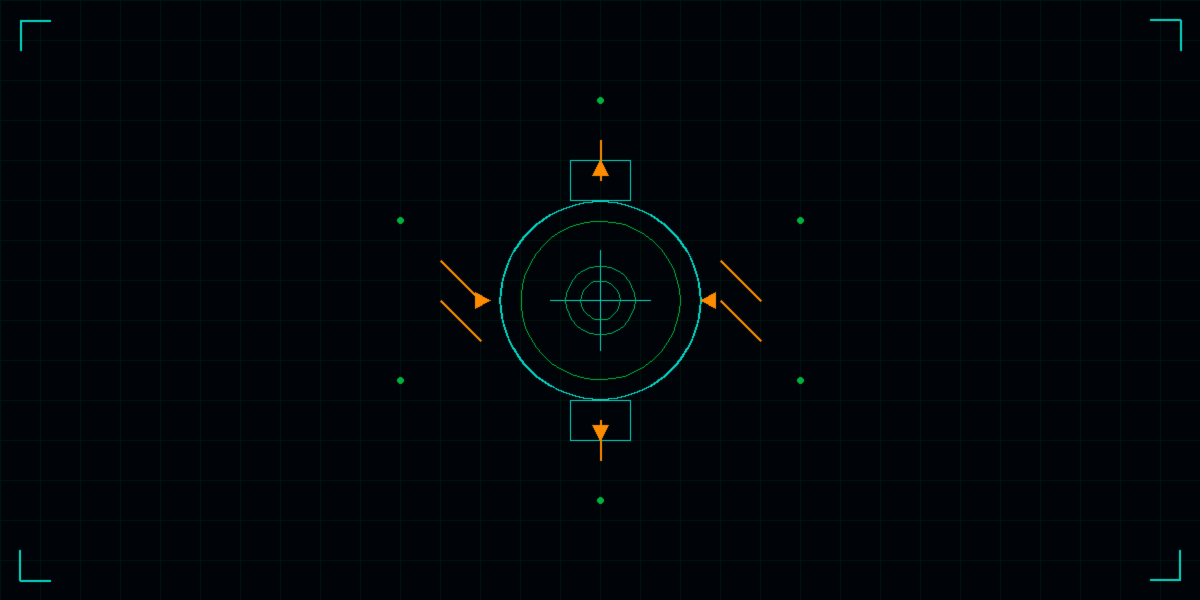
Fresh neutral orientation captured on every session. All tilt input is offset from your starting position, not from absolute gravity. Works in any posture.
A 0.4-unit sensor deadzone eliminates micro-jitter. The flight feels smooth because the physics are smooth — not because the input is artificially sluggish.
Yaw and pitch are independent axes mapped to independent sensor deltas. Banking and climbing are simultaneous. Diagonal inputs decompose cleanly.
Five distinct haptic patterns. 12ms on weapon fire. 120ms on player hit. 400ms on death. The hardware is expressive — the feedback layer uses all of it.
No game engine. No OpenGL. No GPU pipeline. Pure CPU rasterisation — drawLine() calls batched inside a 33ms handler loop. Right-handed 3D coordinate system. Yaw-then-pitch camera transforms. Perspective projection with dynamic focal length.
Primary development device: 2016 legacy hardware. A deliberate choice — if it holds 30fps on the floor, it holds everywhere.
APK size: ~2.6MB. APK. Not gigabytes. Megabytes.
| Renderer | Android Canvas 2D |
| Frame rate | 30fps (33ms loop) |
| Projection | Perspective (W × 0.475) |
| Near / Far plane | 4 / 2,800 units |
| Coordinate system | Right-handed 3D |
| Display | 400×400, circular |
| APK size | ~2.6 MB |
Vector Grid is not a watch game. It is a wearable-native interaction platform. The design language — motion as input, tiny screen as display surface, physical immediacy as the core mechanic — is hardware-agnostic.
The first release runs on Wear OS. Apple Watch support is coming. The engine architecture was designed for this from the start.
The long-term goal: any wearable device with a sensor and a screen is a potential Vector Grid platform.